

Reduce change impacts using the SCARF model
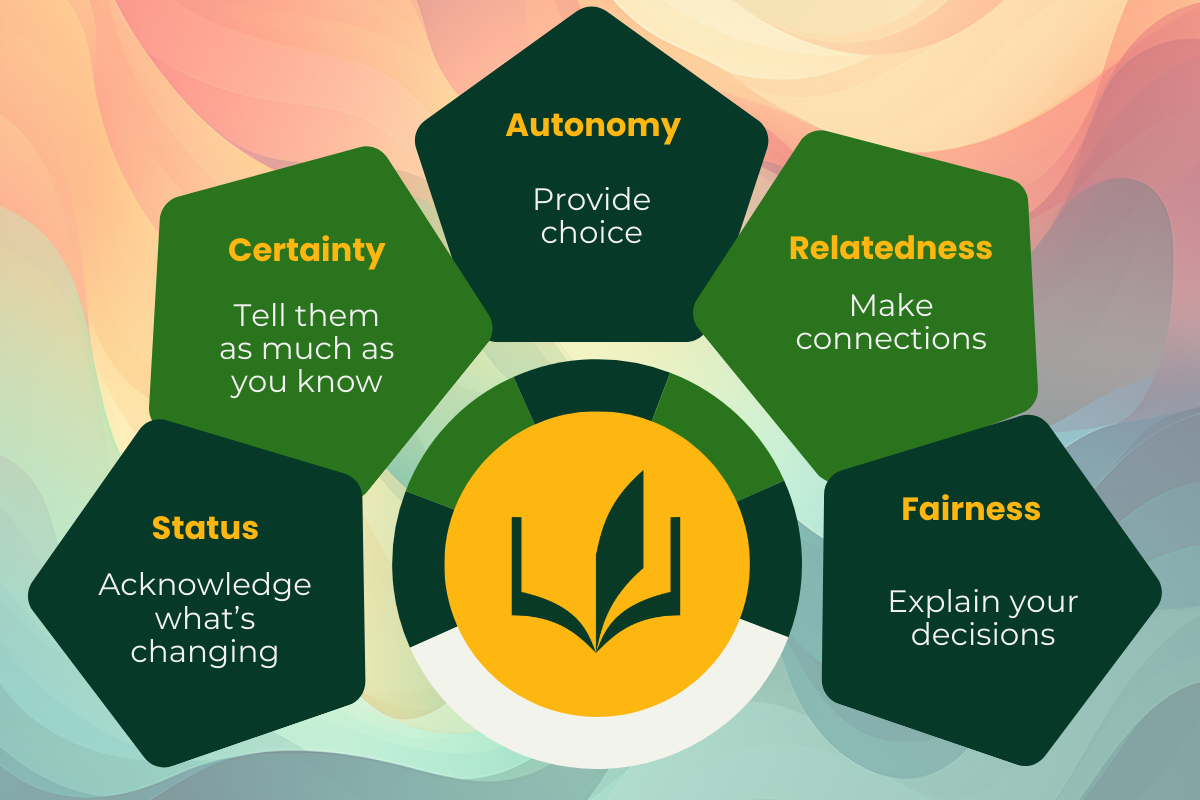
I have been working in change in various forms for pretty much my whole career. And when I say change – I mean organisational change as a concept – not just the role of “Change Manager”. I started off implementing process change in call centres, I transitioned to leading projects, then consulting on the people impact of larger and larger change programs before I began leading them myself.
One of the most useful tools I came across is the SCARF model, I use it all the time to plan and implement change so I thought it would be helpful to share it with you and a little about how I use it.
Your team is made up of individuals
One of the first things I learnt implementing change is that everyone is different. You can’t control the response that people might have to change – or whether they like what you are doing. So how do you communicate what’s going to happen in a way that caters to everyone?
Often implementing change causes some people to act differently – suddenly they are disruptive, quiet, or antagonistic. Whilst it's easy to identify that this is a reaction change, it's too broad a diagnosis generally to be able to address. So what if there was a simple framework to help you understand why individuals might react, and not only help you address their concerns in the moment, but also incorporate it into your ongoing planning?
Introducing the SCARF model
The SCARF model, introduced by Dr. David Rock, offers a straightforward psychological theory of motivation inspired by neuroscience. It focuses on five key factors that significantly impact how we behave:
Status (S): The perception of being considered better or worse than others.
Certainty (C): The predictability of future events.
Autonomy (A): The level of control we feel able to exert over our lives.
Relatedness(R): The sense of having shared goals and being part of the ‘in crowd.’
Fairness (F): The perception that we are being respected and treated fairly in comparison to others.
When these factors are positively influenced, they are highly rewarding. However, under threat, any of these dimensions can trigger a “fight or flight mode”.
In my experience people can react to any of the SCARF items being under threat, but typically individuals seem to have one or two that push their buttons more than others. Fairness is mine – often when I’m frustrated about something I can track it back to my desire for fairness.
Understanding potential triggers
So while our teams are full of individuals, the SCARF model tells us that there are typically going to be 5 key things that cause them to “react”, so we can ensure we address this in our change communications, planning and implementation. Below I’ve given some examples across the SCARF model of items that are likely to cause a reaction one three different change programs.
Status
Description: Individuals who are worried about how they are perceived
Potential Triggers:
New System Implementation: Someone was an expert in how to complete complex transactions in the old system – a “superuser” or just the person that everyone asks for help who now knows nothing about the new system.
Organisation Restructure: Someone’s job title changes and sounds less senior than it was. An additional layer is added in that means they feel like they have been demoted. Someone is missed off the org chart.
Office Move: Someone had “the best spot” in the office because they had been there the longest.
Certainty
Description: Individuals who are worried about what will happen next
Potential Triggers:
New System Implementation: Individuals don’t know what aspects of the system will change and are worried about not knowing how to do things.
Organisation Restructure: Individuals don’t know if they will have a job or not.
Office Move: Individuals don’t know where the new office will be or when they will move and are worried about how they will get there or whether they'll still be able to do things they do now.
Autonomy
Description: Individuals who are worried about being able to choose what to do
Potential Triggers:
New System Implementation: Individuals are told how they need to do things in the new system but like being able to figure it out for themselves.
Organisation Restructure: Individuals are put into a role they don’t want.
Office Move: Individuals are told where to sit but prefer to have choice.
Relatedness
Description: Individuals are worried about personal connections
Potential Triggers:
New System Implementation: Individuals no longer work with colleagues that they used to (because of automation)
Organisation Restructure: Individuals get a new leader or don’t get to work with the same team
Office Move: Individuals are worried they won’t be able to sit with their friends.
Fairness
Description: Individuals are worried about how they are treated during the process
Potential Triggers:
New System Implementation: Who gets selected for “special/privileged roles”.
Organisation Restructure: Individuals perceive favouritism impacts how roles are allocated.
Office Move: Individuals perceive that there is favouritism on who sits where.
Hopefully you can see how the “reaction” gets triggered the same way irrelevant of the change that is happening.
How to use this model to help manage change
Here are some ideas on how to address each one of these reactions.
Status
Acknowledge the change.
Look for ways to ensure future status is equivalent.
If it isn’t, seek out the people impacted and explain your decision.
This seems fairly obvious but you would be surprised how many times I have seen this cause issues. If you have someone in the team who is the person who always knows how to do something complex in your IT system and you are implementing a new one – get them to be a “superuser” in the new system, or even participate in the design. If you are changing someone’s job title think about whether it is an equivalent, and if it isn’t, explain why. I once was involved in an organisation restructure where the organisation had too many layers. Junior team leader, senior team leader, manager, senior manager etc. We unified the layers across the whole business and so spoke to the individuals involved and explained that there was now just “team leader” and “manager”.
Certainty
Say what you know and what you don’t.
Give them an indicative timeframe that they might know.
Communicate the process you will use to make the decision (so they can see the steps play out).
Give them a certain timeframe that they will be updated.
When I’m discussing what we can communicate during change with teams I often hear “we can’t tell them because we don’t know”. But often you do know something – it just might not be everything yet. So tell them that.
“We don’t know which system we’ll use yet, but we’re looking at three and we’ll make a decision by the summer. We’ll give you an update at our next briefing in 4 weeks by which time we’ll have the vendor responses and can tell you more”
It’s particularly hard with organisation restructures as often you can’t tell everyone what’s happening fully out of respect for the individuals who might be going through change. Even then, saying that “we’ve spoken to the people impacted” helps them understand whether they are impacted or not.
Autonomy
Give people choices!!!
I once was working with a leader who really needed autonomy. He did not like receiving advice on how to deliver change messages and would almost always do it a different way even though he was part of a bigger picture where messages all needed to be delivered at the same time and in a similar way because of the sensitivity of the message.
For those people who have a need for autonomy, it’s really helpful to give them some choice – ideally ones that you can cope with. I gave the autonomous the leader some options. “It’s up to you – we can do it this way, this way or this way…. What do you think?”. Giving people the option to nominate which desk they want to sit in or vote on the system you are using can help those who are worried about their ability to choose feel like they have some!
Relatedness
Consider ways relationships will/can be sustained.
Ensure there’s a proactive plan for establishing new connections
I often reframe “relatedness” as “relationships” as to me it’s about those personal connections and change threatens those for people who rely on them. So it’s helpful to think about the ways that relationships will be sustained. If you are moving office – who will you be closer to? Who will you still get to see because they are just around the corner? And how can you make sure that there are new connections being created? If someone is moving to a new team, can you let them meet someone from the team first? Can you allocate them a buddy in the new team?
And of course, there’s always a good excuse for a social get together – a farewell to some people or a welcome to some more.
Fairness
Explain how you are making the important decisions
I said earlier that this is the one that resonates most for me, so it’s no surprise that I think the interventions for this are the most important. But I think that’s partly because this one can be a neutraliser for many of the other issues. If you address fairness, it is much easier to respond to concerns about status, certainty and autonomy.
If you have only changed one person’s job title, it is completely understandable that someone will be concerned about how they are perceived – but if you can show you’ve done it for everyone the same way, it’s much harder to make it just about their status. If you let people pick their own desk in the new office – but do it according to seniority & length of service for example, some people might not like it, but they can see that there was a reason those people got to pick and they didn’t – again, it’s not about the individual.
When SCARF is helpful:
I find the SCARF model useful most of the time, but key points to look out for would be:
Just before you make an announcement about a change – have you provided a response that will satisfy each of the categories?
If someone is acting defensively or seems stressed about the change – assess which of the categories they might be reacting to so you can help them navigate the change.
When you are collating feedback from your business – is there a theme to the questions you are getting that implies one of the above is not addressed?
If you want to know more about the SCARF model you can read a more detailed article here or visit the Neuroleadership Institute website.
For support for you or your leaders in implementing change with your team, you can contact us or click here for more information on our Change Leader capability packages.